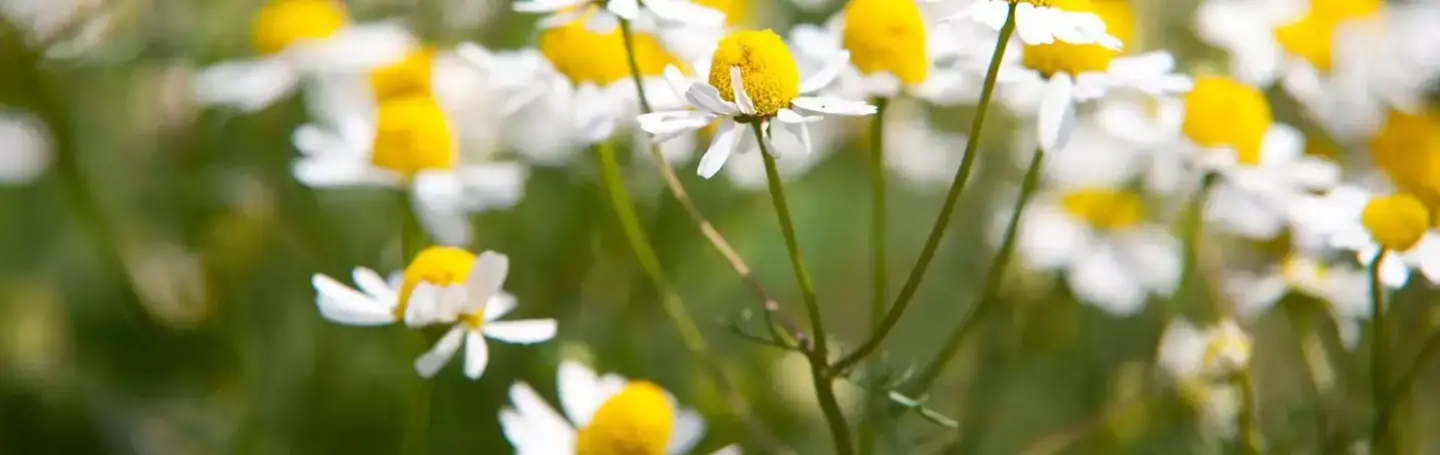
Chamomile has been known as a medicinal plant since ancient times. It is believed to be a real protective agent for body and soul. The warm, enveloping scent provides comfort and calms fears. Chamomile has also been shown to care for stressed skin and is considered a popular female herb for its nervine properties.

Harvest
Optimal harvest maturity is when the white corolla of the flower is only half open.

Part of the plant
The color of the plant

Extraction method
Steam distillation
Oil for regeneration and comfort
German chamomile grows along roadsides, rocky slopes and fields throughout Europe. It is an annual herbaceous undemanding plant. It can reach up to 50 cm in height and has white, characteristically fragrant flowers. The hollow base of the flowers is considered a distinguishing feature compared to Roman chamomile, which has a similar aroma but has different medicinal properties.
German chamomile essential oil has a blue hue that sets it apart from most other essential oils . Although its flowers are smaller than those of Roman chamomile, German chamomile is very powerful!
| Botanical name Chamomilla recutita (Matricaria recutita) | Aroma profile Grassy, enveloping, warm |
| family Asteraceae /Compositae | fragrance Middle note |
| Origin Southern and Eastern Europe | application For skin care and regeneration, relaxes anxiety, soothes. |

Application and effect
German chamomile has soothing and skin rejuvenating properties. In naturopathy, it is used for respiratory, stomach and intestinal complaints, as well as for various skin problems. At the same time, chamomile strengthens the nerves and is considered a typical herb for mothers and women.
| Mental Application: In case of exhaustion, stress, restlessness, anxiety, sleep disorders | Psychological action: Soothing, restorative, balancing, strengthening |
| Physical Application: Impurities on the skin, skin inflammations, for scar care, for neurodermatitis | Physical action: Antibacterial, strong anti-inflammatory, antifungal, antispasmodic, pain reliever, skin care, skin regeneration, antipruritic |
Recipes with German (blue) chamomile essential oil

Oil for dry and cracked skin
- 50 ml organic aloe vera oil
- 2 drops Blue Organic Chamomile
- 1 drop Roman chamomile
- 3 drops organic Lavender
Add essential oils to aloe vera oil , shake well, and apply to affected areas of skin. Lavender provides additional soothing benefits.
Blue Hour Bath Salts
- 1 kg of sea salt
- 10 drops Blue Organic Chamomile
- 10 drops Lavender fine
- 10 drops Rose 10%
- 3 drops Neroli 10%
- 2 drops Benzoic Siam
Drop the essential oils into a jar. Add sea salt and close the jar. Shake well to allow the sea salt to mix with the essential oils. Add 3 tablespoons to running bath water. Neroli and Benzoin Siam oil provide an incomparable feeling of relaxation.
Conclusion
The information in this article is for educational purposes only and is not intended to serve as a basis for prevention or treatment.
Ð ~ Ð · Ñ, Ð ¾ Ñ ‡ Ð ½ Ð ¸ Ð º: https://www.primaveralife.com/wissen/pflanzenglossar/kamille
Photos: Primavera Life
More interesting articles from the blog
- Aloe vera oil in aromatherapy – benefits and uses
- Lavender essential oil – the oil of antiquity
- Roman Chamomile Essential Oil – Benefits and Uses
- Benzoin Siam Essential Oil – Benefits and Uses
- Essential oils – uses and benefits in aromatherapy
Categories
18.95 €Add to cart
 Discount: -20%
Original price was: €41.90.33.52 €The current price is: €33.52.Add to cart
18.95 €Add to cart