
We’ve written about argan oil , rosehip oil, jojoba oil, calendula oil, almond oil, castor oil … the list goes on and on. But today we’re going to introduce you to an exotic oil that’s worth a try: organic sea buckthorn oil , also known as sea buckthorn. If you’re looking for a moisturizing oil that’s rich in antioxidants, has a great power in terms of nutrient content, and is well-tolerated by all skin types – from oily to dry, then this is your base oil.

Sea buckthorn oil boasts an impressive profile of essential fatty acids, vitamins, minerals, and antioxidants, making it a powerful skincare ingredient.
In this article, we'll talk a little more about the skin care benefits of sea buckthorn oil, and give tips on how best to use it in your routine.
What is it and how is organic sea buckthorn oil extracted?
Hippophae rhamnoides or sea buckthorn oil can be extracted from both the fruit and the seeds of the shrub. While both oils are exceptional for use in skin care, they differ in their appearance and properties. Sea buckthorn fruit oil is thicker and dark orange or red due to a higher level of carotenoids and is resistant to oxidation, while sea buckthorn seed oil is less viscous and has a less intense orange hue with less oxidative stability than the fruit oil.
Sea buckthorn oil is rich in various vitamins, minerals and beneficial plant compounds. Its fruits are rich in vitamins A, C, K and E. They also contain significant amounts of iron, calcium, magnesium, potassium, copper and zinc. In addition, its seeds and leaves are rich in phytosterols – a plant compound with many benefits – including blocking the body's absorption of cholesterol from food.
The oil has a high proportion of palmitoleic acid, which is also found in the fats of human skin. Therefore, this oil is believed to speed up wound healing and keep the skin healthy.
Interestingly, sea buckthorn oil may also be one of the few plant foods known to provide all four omega fatty acids. What's more, more than half of the fats contained in this oil are mono- and polyunsaturated fats, which are two types of healthy fats.
5 skin benefits of organic sea buckthorn oil

Sea buckthorn fruit has been found to contain 10 times more vitamin C than an orange and is the third highest source of vitamin E among plants.
- Rich in Antioxidants: If you want to fight pesky free radicals, it's worth adding sea buckthorn oil to your routine. It is rich in vitamin C, vitamin A, alpha- and beta-carotene, vitamins B1, B2 and B6, vitamin E, fatty acids and flavonoids, Omega 3, 6, 9 and the rarest Omega 7 and about 190 bioactive compounds.
- Moisturizes the skin while regulating oiliness: Sea buckthorn oil helps keep your skin beautiful and moisturized. It helps as a humectant as it contains linoleic acid, which is naturally found in the skin's sebum. It regulates moisture and hydration levels.
- Improves skin tone: Sea buckthorn oil helps to even out skin tone and helps fade post-inflammatory hyperpigmentation. It can improve overall skin tone, texture, and elasticity.
- Prevents moisture loss: The oil helps prevent transepidermal water loss, which helps the skin maintain its lipid barrier.
- Reduces fine lines and wrinkles: Thanks to its rich content of antioxidants, fatty acids and vitamins, sea buckthorn oil can help improve the appearance of the skin.
How to use sea buckthorn oil for skin
Sea buckthorn oil is versatile and can be used both alone and in moisturisers, eye creams or oil blends.
It is recommended to mix the oil with organic jojoba oil or almond oil in a ratio of 1:10 (1 tsp sea buckthorn oil and 10 tsp jojoba oil ). The oil absorbs quickly without leaving a greasy film. It can also be used alone – add a few drops to your palms and apply as a step before sunscreen in the morning or as the last step of your routine in the evening. Remember, your skin should be damp! Use it once a day, in the morning, after applying moisturizer, floral water or other hydrating product, to seal in hydration.
Be careful, as the oil has an orange color. Once absorbed, there is no staining on the skin of the face or body.
An interesting story about sea buckthorn oil
Sea buckthorn is one of the oldest known terrestrial plants, whose therapeutic properties have been widely used in medicine in Asia for millennia.
Among the oldest sources mentioning sea buckthorn are treatises by Tibetan monks. However, sea buckthorn gained recognition around 200 BC, during the military campaigns of Alexander the Great. Then, exhausted soldiers noticed that their horses were eating leaves and fruits of unknown trees, and decided to try them. Just a few days later, the soldiers and horses regained their strength and were full of energy. Since then, this fruit has been called by the Latin name “Hippophae”, which means “shining horse”. Alexander the Great brought the fruit trees to Europe. Sea buckthorn is also widespread in Asia, Europe, Russia, and recently in Canada.
According to another legend, Genghis Khan, the emperor of Mongolia, who created one of the largest empires in the 13th century, relied on 3 cornerstones: a well-organized army, strict discipline, and sea buckthorn.
The first scientific biochemical analysis of sea buckthorn was done in 1929. and has been the subject of numerous studies ever since.
More interesting articles from the blog
- Rosehip oil – the fountain of youth
- Jojoba oil – benefits and uses for skin and hair
- Almond oil – properties for skin and hair
- St. John's wort oil - benefits and uses
- Argan oil – the gold of Morocco
Categories
- Aromatherapy
- Essential oils
- Carrier oils
- Diffusion methods
- Natural cosmetics
- Recipes with essential oils
- News

Conclusion
The information in this article is for educational purposes only and is not intended to serve as a basis for prevention or treatment.
Sources:
- Wikipedia
- www.aromaweb.com
- https://www.ncbi.nlm.nih.gov/pmc/articles/PMC6589177/
- https://www.ncbi.nlm.nih.gov/pmc/articles/PMC6162715/
- https://www.healthline.com/nutrition/sea-buckthorn-oil#2.-May-protect-your-skin
Written and translated by: Kremena Petrova.
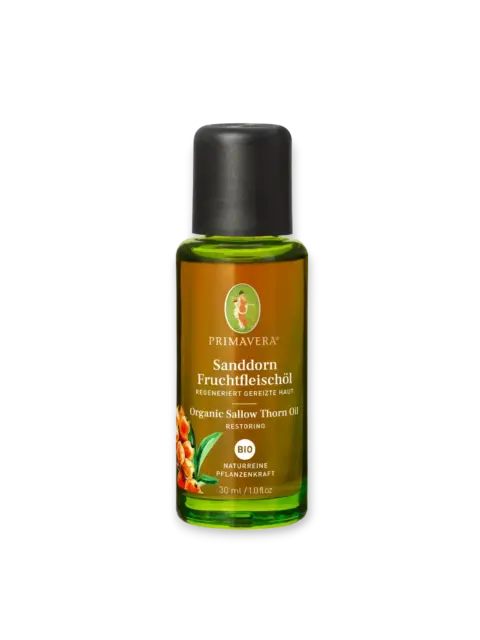
Photos: Primavera Life, Adobe Stock, all rights reserved
 Discount: -20%
Original price was: €31.90.25.52 €The current price is: €25.52.Add to cart
13.95 €Add to cart

17.85 €Add to cart
12.75 €Add to cart
 Discount: -20%
Original price was: €19.90.15.92 €The current price is: €15.92.Add to cart


